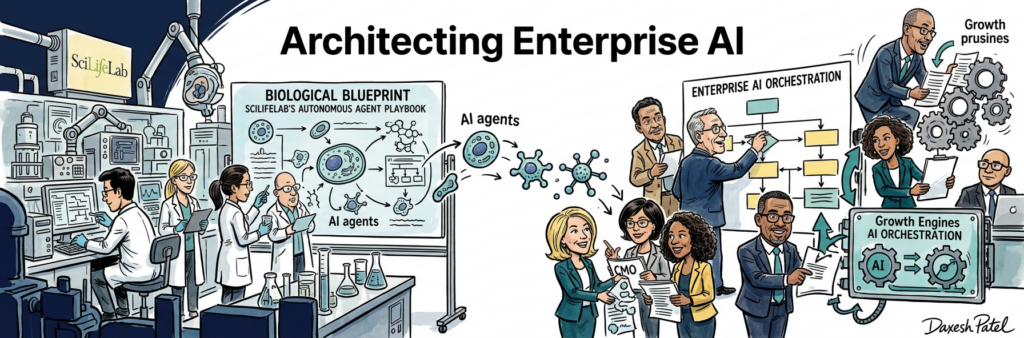
The Biological Blueprint for Digital Transformation
On 5 March 2026, researchers at SciLifeLab in Stockholm initiated a project that, on the surface, had nothing to do with commercial marketing. They gathered to develop autonomous AI agents designed to seamlessly integrate vast repositories of biological data and orchestrate highly complex scientific research pipelines. Their objective was to solve a fundamental problem in modern science: human researchers were drowning in fragmented, siloed data sets across genomics, proteomics, and clinical trials. The biological digital transformation they pioneered did not just accelerate research; it fundamentally altered how data informs outcomes.
When I reviewed the architecture of the SciLifeLab deployment, I did not see a medical breakthrough. I saw the exact operational blueprint required to rescue the modern enterprise marketing department.
Having managed in excess of £30 million in global marketing budgets over my two decades in digital growth, I can tell you that enterprise Chief Marketing Officers are fighting the exact same battle as those Stockholm scientists. Our marketing tech stacks have become hopelessly fragmented. We have isolated pipelines for paid media bid streams, customer relationship management (CRM) databases, conversion rate optimisation (CRO) insights, and enterprise search engine optimisation (SEO). We are drowning in data, yet starved of orchestrated action.
The prevailing market narrative suggests that adopting AI is simply a matter of procuring new software to automate copywriting or generate predictive models. This is a catastrophic miscalculation. Deploying autonomous AI agents to orchestrate complex commercial pipelines is not a technology upgrade; it is a violent disruption to legacy workflows. It is, at its core, a change management challenge. When executed correctly, integrating autonomous agents into enterprise operations breaks down entrenched data silos, eliminates systemic bottlenecks, and drives massive Return on Ad Spend (ROAS) uplifts. When executed poorly, it merely accelerates the production of operational friction.
Why the Current Consensus on AI Integration is Fundamentally Flawed
The consensus among enterprise leadership today is that AI should be implemented as a plug-and-play efficiency lever. Boards instruct their marketing directors to ‘use AI’ to reduce agency retainers or speed up content production. This isolated, tool-centric approach fundamentally misunderstands the capabilities of autonomous AI agents.
An autonomous agent, as demonstrated by the SciLifeLab framework, is not a passive tool waiting for a human prompt. It is a persistent digital entity capable of independent decision-making, cross-platform data integration, and pipeline orchestration. In a commercial context, an autonomous agent does not just analyse an underperforming paid media campaign; it identifies the latency in the data flow, cross-references it with real-time inventory levels in the enterprise resource planning (ERP) system, and dynamically reallocates budget across international borders without human intervention.
The flaw in the current consensus is the assumption that exponential technology can be seamlessly plugged into linear, legacy workflows. Enterprise marketing departments are structurally designed around human bottlenecks. We have approval matrices, quarterly budget planning cycles, and departmental divisions between IT, data science, and performance marketing. If you deploy an autonomous agent capable of executing thousands of data integrations per second into an organisation that requires a two-week email chain to approve a budget shift, the technology will fail.
The primary bottleneck preventing digital transformation is no longer computational capability; it is organisational rigidity. Treating autonomous orchestration as an IT procurement exercise rather than a root-and-branch restructuring of marketing operations guarantees a negative return on capital expenditure.
The Operational Evidence the Market is Missing
During my tenure directing global enterprise campaigns, the difference between a functional marketing strategy and one that delivers a 123% ROAS uplift has consistently come down to data latency and capital deployment velocity. When you are managing a global budget of £30 million, marginal inefficiencies scale violently.
Consider the operational reality of managing multi-region digital media. In a traditional enterprise, human operators must extract data from demand-side platforms (DSPs), harmonise it with CRM pipelines, wait for attribution modelling from the data team, and then manually adjust bids. This cycle often takes days. By the time the decision is made, the market dynamics have shifted, and the allocated capital is immediately inefficient.
The SciLifeLab researchers recognised this exact friction in biological research. They noted that manual data harmonisation delayed clinical insights by weeks. By deploying autonomous agents, they reduced the time from data ingestion to pipeline execution to mere seconds.
Translating this to the commercial sphere reveals the evidence the broader market is ignoring. Enterprise leaders are fixated on reducing the cost of media acquisition rather than increasing the velocity of data orchestration. If an autonomous agent can ingest search intent data, integrate it with real-time conversion metrics, and adjust a global media portfolio autonomously, the commercial outcome is not just ‘efficiency’—it is absolute market dominance. The autonomous agent acts as the connective tissue between disparate data silos, forcing cross-functional alignment. The evidence is clear in the balance sheet: organisations that restructure their human teams to manage these agents, rather than compete with them, achieve scalable growth engines that defy traditional diminishing returns on ad spend.
Contrasting Paradigms: The True Cost of Misunderstanding Autonomous Agents
To understand the strategic pivot required, we must contrast the traditional enterprise approach to digital transformation with the autonomous orchestration model pioneered by advanced research facilities like SciLifeLab. The table below illustrates the critical differences in methodology, the inherent risks of maintaining the status quo, and the commercially sound response required from senior leadership.
| Conventional View | Research Finding (SciLifeLab Model) | Strategic Risk | Better Response (Commercial Application) |
|---|---|---|---|
| AI is an isolated tool for specific tasks (e.g., content creation, bidding). | Autonomous agents orchestrate end-to-end multi-disciplinary pipelines continuously. | Sub-optimisation; creating faster silos without improving the overall system throughput. | Deploy agents as central nervous systems to connect fragmented marketing and sales data silos. |
| Digital transformation is an IT procurement responsibility. | System integration requires structural redesign of how inputs inform automated actions. | Massive capital waste; technology fails to deploy due to legacy operational friction. | Treat AI deployment strictly as a cross-departmental change management protocol. |
| Human operators must manually review and approve all data transfers and budget shifts. | Agents autonomously ingest, harmonise, and execute complex workflows without human latency. | Loss of market share due to critical delays in capital deployment and campaign agility. | Transition humans from operational ‘doers’ to strategic ‘supervisors’ of autonomous agents. |
| Success is measured by the reduction of departmental headcount or software costs. | Success is defined by the speed, scale, and accuracy of pipeline orchestration. | A race to the bottom; cost-cutting destroys the capacity for scalable revenue generation. | Anchor agent deployment KPIs to aggressive commercial metrics: ROAS uplift and revenue growth. |
Visualising the Impact: Pipeline Velocity and Commercial Output
The core advantage of the SciLifeLab framework is the dramatic compression of time between data generation and executed outcome. When we map their findings regarding biological data integration onto enterprise marketing operations, the disparity between legacy systems and autonomous orchestration becomes glaringly apparent.
Below is a diagnostic visualisation of workflow throughput. It contrasts the traditional manual marketing pipeline—plagued by latency and human handover friction—against an autonomous agent-orchestrated pipeline.
Throughput Analysis: Legacy Pipelines vs. Autonomous Orchestration
Mapping the March 2026 SciLifeLab data integration findings to enterprise marketing data velocity and ROAS impact.
94% Faster
Reduced by 82%
Up to 123%
Strategic Takeaway: Leaders must stop viewing AI as a tool for content generation and start viewing it as a systemic orchestrator. The commercial advantage lies entirely in the reduction of workflow bottlenecks, allowing data to transition into profitable action without human latency.
What Leading Commercial Teams Understand Earlier Than Everyone Else
The most sophisticated commercial teams—those capable of scaling £30 million budgets into highly profitable global revenue streams—understand that technology adoption is entirely secondary to organisational design. You cannot operate a 2026 autonomous data pipeline using a 2015 marketing department structure.
Leading CMOs and digital transformation executives understand that the role of the human marketer is changing fundamentally. In a legacy system, marketers are ‘doers’; they pull levers, write copy, export CSV files, and manually adjust bids. In an autonomous agent-driven ecosystem, the marketer transitions to a ‘supervisor’ or ‘strategist’. Their role is to dictate the commercial constraints, define the acceptable risk parameters for the AI agent, and align the output with broader business objectives.
This requires a profound shift in capability building. I have been brought into countless enterprise scenarios to act as an interim leader precisely because the incumbent teams were overwhelmed by their own technology. The software was operating efficiently, but the human infrastructure was fundamentally misaligned. Leading teams dismantle the traditional barriers between their IT departments, their data science units, and their marketing execution teams. They realise that when an autonomous agent is orchestrating the pipeline, a delay caused by inter-departmental politics is a direct attack on the company’s profit margins.
Furthermore, these forward-thinking leaders recognise the necessity of robust change management. They do not announce an AI rollout in a company-wide email. They carefully restructure incentives, retrain key personnel, and rigorously map out the new workflows required to support an autonomous orchestrator. They understand that breaking down data silos is not a technical challenge; it is a leadership mandate.
Five Practical Leadership Recommendations for Autonomous Agent Deployment
If you are a senior executive preparing to implement autonomous AI agents to modernise your digital marketing operations, you must abandon standard procurement playbooks. Based on my direct experience engineering massive ROAS uplifts and leading global digital overhauls, here are five rigorous recommendations focused entirely on commercial prioritisation and resource allocation.
1. Audit Legacy Bottlenecks Before Assessing Technology Stacks
Do not evaluate a single AI vendor until you have mapped your current operational friction points. Document the exact number of hours it takes for your enterprise to move from raw data ingestion to a live campaign adjustment. Identify where human approvals cause fatal latency. The autonomous agent’s primary job will be to replace these specific bottlenecks. If you layer advanced AI over broken processes, you will simply automate your own dysfunction.
2. Treat AI Deployment Strictly as a Change Management Protocol
Acknowledge that autonomous orchestration will threaten the perceived value of your current middle management. You must proactively manage this structural shift. Design comprehensive change management protocols that clearly outline how job roles will evolve from manual execution to strategic oversight. Secure absolute executive buy-in for this transition, and communicate that the objective is to elevate human capabilities, not merely to rationalise headcount.
3. Restructure Cross-Functional Teams Around the Agent
Siloed departments are the enemy of autonomous orchestration. You can no longer afford to have a performance marketing team that requires a two-week ticketing process to request data from the analytics department. Realign your teams into agile, cross-functional pods consisting of a commercial strategist, a data engineer, and a media buyer, all functioning together to supervise the autonomous agent. The agent is the central processor; the team is the governance layer.
4. Ring-Fence Budgets Specifically for Operational Integration
A catastrophic error I see frequently is enterprise boards approving a massive budget for the AI software licence, but allocating zero capital for the operational integration. Ring-fence at least 30% of your total transformation budget strictly for process redesign, API connectivity, legacy data cleansing, and staff retraining. The cost of the agent is negligible compared to the cost of modifying your enterprise to accommodate it.
5. Anchor Agent Deployments Exclusively to Commercial Outcomes
Do not allow your digital transformation to be measured by vanity metrics such as ‘hours saved’ or ‘reports generated’. As a commercial leader, you must tie the autonomous agent’s performance directly to the balance sheet. Establish rigorous KPIs focused on measurable ROAS improvements, customer acquisition cost (CAC) reduction, and top-line revenue growth. If the deployment of the agent does not demonstrably improve your commercial efficiency, the implementation strategy is flawed and must be audited immediately.
The Commercial Reality of Autonomous Orchestration
The researchers at SciLifeLab in Stockholm did not integrate their biological data pipelines because it was fashionable; they did it because the sheer volume and complexity of the data demanded a new paradigm of orchestration. Enterprise digital marketing has reached that exact inflection point.
We are operating in a commercial environment where managing multi-million-pound media portfolios across fragmented global markets has surpassed human computational limits. Relying on isolated software tools and siloed departments to manage this complexity is an exercise in managed decline. The implementation of autonomous AI agents offers an unparalleled opportunity to break down these silos, eradicate operational latency, and drive unprecedented commercial efficiency. But this cannot be achieved through passive procurement.
It requires a digital growth leader willing to dismantle outdated departmental structures and enforce rigorous, commercially focused change management. The enterprise of tomorrow will not be defined by the AI it buys, but by the legacy operations it is willing to destroy.