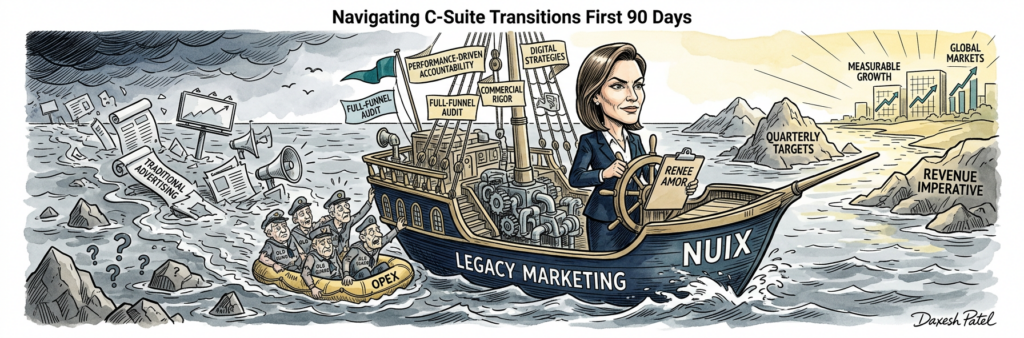
The Executive Illusion: Why a New CMO’s First 90 Days Must Be Ruthlessly Commercial
On 6 March 2026, the investigative analytics software giant Nuix announced a strategic executive shuffle, appointing former Rabobank executive Renee Amor as Chief Marketing Officer. Her explicit mandate: to spearhead global growth, digital performance, and brand communications. In the enterprise technology sector, this type of high-stakes executive transition is incredibly common, yet the immediate playbook deployed by incoming marketing leaders is almost universally flawed.
The common assumption in the corporate world is that an incoming enterprise CMO must spend their first ninety days embarking on a global ‘listening tour’. The accepted wisdom dictates that a new marketing leader should focus primarily on realigning the brand vision, understanding internal departmental culture, and mapping out a twelve-month strategic transformation plan before making any drastic operational changes. The focus is placed entirely on consensus building and strategic posturing.
The evidence from the operational trenches of managing £30M+ global marketing budgets points elsewhere entirely. While a new executive is busy listening and whiteboarding brand architectures, the legacy digital performance engine is actively haemorrhaging cash. My contrarian stance, forged over two decades of architecting digital growth and AI marketing automation, is that you simply do not have the luxury of a ninety-day cultural assimilation. The first thirty days must be an aggressive, forensic audit of your full-funnel performance media, halting budget bleed, and establishing rigid commercial accountability. When you inherit a legacy marketing department, your primary directive is not brand consensus; it is immediate revenue efficiency.
Section 1: The Default Enterprise Playbook and Why Marketers Follow It
When a new executive steps into a global enterprise role—whether at a complex investigative analytics firm like Nuix or any other large-scale B2B technology provider—they inevitably inherit a sprawling web of legacy agency contracts, fragmented regional budgets, and disparate tracking systems. The default playbook dictates that the new leader should commission an expensive external brand audit, consolidate creative agencies, and launch a new overarching brand campaign to signal a ‘new era’ to the board. Meanwhile, the performance marketing tier—paid search, paid social, programmatic media, and landing page optimisation—is left running on autopilot, entrusted to middle management or external vendors who are graded on vanity metrics rather than bottom-line commercial impact.
Marketers continue to follow this archaic playbook because brand strategy is subjective, and subjectivity is a safe harbour for a newly appointed executive. It is substantially easier to debate typography, brand positioning statements, and top-of-funnel messaging than it is to confront a massive paid media budget that is delivering an abysmal return on ad spend (ROAS). Performance data is entirely ruthless. It exposes inefficiencies immediately and leaves no room for corporate obfuscation. Incoming leaders often avoid dismantling the digital performance engine out of fear that they will inadvertently break the one system generating steady, albeit highly inefficient, lead flow for the sales department.
Furthermore, legacy marketing departments are typically structured in rigid silos. The brand team sits isolated from the paid media execution team, while the conversion rate optimisation (CRO) and analytics teams operate in a complete vacuum. This structural dysfunction allows generic marketing theory to thrive while operational realities are wholly ignored. New executives follow the default playbook because challenging these entrenched silos requires a level of technical performance marketing expertise that many traditional, brand-focused CMOs simply do not possess. They rely on the existing frameworks, allowing bloated cost-per-acquisition (CPA) figures and stagnant click-through rates (CTR) to slowly erode their overall commercial impact and credibility with the CFO.
Section 2: What the Numbers Actually Show When You Audit the Engine
When you bypass the high-level brand narrative and dig directly into the performance marketing data of an enterprise organisation, the numerical reality is often staggering. Throughout my career directing digital growth and interim digital transformations, I have consistently found that legacy marketing departments disguise massive operational friction behind aggregated, high-level reporting designed to placate stakeholders.
Consider the granular metrics. When I audit a £30M+ global media budget, I routinely uncover that up to 40% of the paid search budget is being wasted on broad-match keyword expansion and unchecked automated bidding algorithms that generate absolutely zero qualified pipeline. The numbers show that enterprise teams frequently celebrate a 90% impression share on branded search terms, completely ignoring the fact that organic search (SEO) was already successfully capturing that exact traffic. In reality, the paid media budget is simply cannibalising free revenue, driving up the overarching CPA, and crushing overall revenue efficiency.
Let us examine specific figures derived from rigorous commercial audits. In typical legacy setups, I routinely see complex B2B campaigns operating with a decaying CTR of 0.8% and a conversion rate (CVR) hovering around a dismal 1.2% on core enterprise landing pages. The externally reported ROAS might sit at a seemingly acceptable 250%, but when you strip away the branded search inflation and the low-intent retargeting fatigue, the true non-brand ROAS often plummets to a negative return. By deploying a ruthless focus on full-funnel measurement, the data proves what is actually possible. In my own deployments, shifting the departmental focus from top-line traffic generation to rigorous CPA and CVR optimisation has yielded a 123% ROAS uplift within a single fiscal quarter. The numbers unequivocally show that when you implement cross-market commercial accountability, the entire financial trajectory of the business changes.
Section 3: Dissecting Assumptions vs. Commercial Realities
To scale global marketing departments effectively and avoid the pitfalls of the standard executive transition, you must dismantle the accepted myths of enterprise media management. Below is a breakdown of common tactical plays deployed by legacy teams, the assumptions driving them, the actual data points I uncover during deep-dive audits, and the real commercial implications you must address.
| Common Tactic | Reported Assumption | Data Point Discovered | Real Implication |
|---|---|---|---|
| Maximising brand term impression share via automated bidding. | We must defend our brand territory from competitors to maintain lead volume. | 90% impression share, but 65% of clicks would have converted organically via enterprise SEO. | Artificial ROAS inflation. Massive budget cannibalisation actively destroying true revenue efficiency. |
| Relying on legacy static creative for B2B programmatic display. | Enterprise buyers do not respond to dynamic or rapid creative testing. Consistency is key. | CTR stagnant at 0.4%; CPC has increased by 45% year-on-year due to ad fatigue. | High CPA bloat. The lack of creative velocity is punishing algorithmic delivery and burning cash. |
| Directing global paid traffic to generic, unoptimised homepage domains. | The corporate homepage explains our complex software ecosystem best. | Landing page CVR stuck at 1.1% with a 78% bounce rate on non-brand search traffic. | Without dedicated, message-matched landing pages, bottom-of-funnel paid media spend is effectively wasted. |
| Siloed regional budget allocations (APAC, EMEA, NA) with fixed quarterly caps. | Regional managers require predictable budgets to execute localized marketing plans. | EMEA generates a £450 CPA while APAC sits at £1,200 CPA, yet funds cannot be dynamically shifted. | Severe capital inefficiency. High-performing regions are starved of scale while underperforming regions burn budget. |
Section 4: The Performance Marketing Transformation Dashboard
To truly comprehend the magnitude of operational friction in legacy systems, we must visualise the financial shift that occurs when a leader enforces strict accountability. The following data visualization represents a real-world scenario of a £30M budget undergoing a 90-day turnaround, moving from vanity metric obsession to commercial reality.
First 90 Days: Budget Efficiency & Metric Transformation
Legacy State (Day 1)
Optimised Engine (Day 90)
Strategic Analysis: Marketers must notice that the total required budget actually decreases initially as cannibalisation is eliminated. By identifying and cutting the 40% of wasted spend masking itself as ‘brand defence’, and concurrently fixing landing page CVR from 1.2% to 3.8%, the cost per acquisition (CPA) drops precipitously. The result is a 123% increase in ROAS without requesting additional budget from the board.
Section 5: The Contrarian Lesson Strong Teams Apply
The most critical contrarian lesson that elite enterprise marketing teams apply is the total and unyielding integration of creative, brand, and performance under a single, data-led commercial framework. When a new executive takes the reins, the immediate realisation must be that brand communications and digital performance are not separate disciplines to be managed by different vice presidents. In the modern digital landscape, your brand is defined precisely by the relevance of your creative testing and the frictionless experience of your landing pages. Brand is performance.
Strong leadership teams do not wait for a monolithic brand overhaul to improve performance. Instead, they use rapid, high-frequency creative testing in paid media to proactively dictate the brand messaging. Rather than guessing what the market wants in an insular boardroom, they push fifty different creative variations into paid social, search, and programmatic channels, closely monitoring CTR and CPC at a granular level. The creative narrative that successfully drives the lowest CPA and highest CVR actively informs the global brand strategy, entirely reversing the traditional corporate marketing flow.
Furthermore, strong leaders apply a ruthlessly unified approach to full-funnel measurement. They do not allow regional marketing managers in EMEA, APAC, and North America to report using distinct, self-serving attribution models. They enforce a single source of truth for revenue efficiency. If a regional campaign cannot demonstrate a clear, mathematical path to ROAS or a strategically justified impression share that mathematically assists the broader conversion pipeline, that campaign is paused immediately. This contrarian approach turns marketing from a siloed art form into an integrated, commercially accountable science. It requires seasoned operational leadership—an operator who understands the granular mechanics of AI marketing automation, conversion rate optimisation, and programmatic bidding just as deeply as they understand board-level revenue reporting.
Section 6: Five Concrete Actions for Immediate Commercial Impact
To transform a bloated enterprise marketing department into a scalable, highly measurable growth engine, you must move beyond generic strategy and implement rigid operational frameworks immediately. Drawing from my experience architecting digital turnarounds, here are five concrete actions tied directly to measurable commercial KPIs that any senior leader must execute.
1. Audit Impression Share for Search Cannibalisation
You must immediately run a search query report comparing your paid branded impression share against your enterprise SEO rankings. Invariably, you will find that automated bidding strategies are artificially inflating your CPC by bidding aggressively on terms where you already rank organically in position one. By reigning in exact match brand bidding and reallocating that budget toward high-intent, non-brand B2B search queries, you instantly improve your true revenue efficiency. Measure this success by tracking the reduction in blended CPA and the preservation of organic search volume.
2. Deploy Rapid-Fire Creative Testing Protocols
Halt the deployment of static, high-production-value legacy creative that takes months to produce. Implement a dynamic creative testing protocol using AI-assisted asset generation to test hundreds of ad variations simultaneously across paid social and programmatic channels. Your primary focus here must be on driving up the CTR while simultaneously driving down the CPC. When algorithms see a high CTR, your CPC drops, allowing your budget to stretch further. Force your creative agencies to operate on performance metrics, not aesthetic deliverables.
3. Architect Conversion-Obsessed Landing Pages
Never direct highly targeted, expensive performance media traffic to your corporate homepage. You must deploy isolated, message-matched landing pages designed exclusively for conversion. Strip away navigation menus, heavy corporate jargon, and operational friction. Implement rigorous A/B testing on forms, calls-to-action, and value propositions. By solely focusing on increasing the CVR, you create a multiplier effect on your advertising spend, dramatically lowering your CPA without needing to alter your media buying strategy at all.
4. Centralise Global Budget Allocation with Fluid Capital
Eliminate the antiquated system of fixed quarterly regional budgets. Marketing capital must be entirely fluid, dynamically shifting to the regions, platforms, and campaigns that demonstrate the highest ROAS. If a campaign in APAC is generating a 400% ROAS while a campaign in North America is operating at a loss, the budget must be reallocated within hours, not at the end of the financial quarter. Centralise this control using automated performance dashboards to ensure global scaling is mathematically justified.
5. Establish Cross-Market Commercial Accountability
Eradicate vanity metrics from executive reporting. Regional directors and agency partners must be forbidden from reporting on ‘reach’, ‘engagement’, or ‘brand lift’ as primary metrics of success. Establish a strict reporting framework where every marketing initiative is graded on its ability to drive qualified pipeline and revenue efficiency. By forcing commercial accountability at every level of the department, you align marketing operations directly with the CFO’s bottom line, ensuring every pound spent is an investment in measurable growth rather than an operational expense.
Conclusion
Enterprise marketing leadership is not an exercise in subjective storytelling; it is the rigorous management of mathematical probabilities, operational efficiency, and scalable digital systems. Whether you are leading a transition at a global tech giant or restructuring an underperforming mid-market department, the mandate remains identical: you must architect a measurable growth engine where every tactic is tethered to undeniable revenue efficiency. If you lack the internal operational expertise to execute these complex, data-backed frameworks, finding a strategic partner with a proven record of managing £30M+ budgets and driving triple-digit ROAS uplifts is not a luxury—it is your most urgent commercial imperative.
